The good news: there's no shortage of options in 2026. Some platforms focus on pipeline management, others lean into marketing automation, and a few, like Vedain CRM, pack both into a single flat-rate plan at $10/user/month with zero feature tiers. The CRM market has matured, and buyers now have genuine leverage to pick tools that match how their teams actually work.
This guide breaks down 15 HubSpot alternatives worth considering, whether you're a startup running lean or a mid-sized sales org that's outgrown HubSpot's pricing model. For each platform, you'll get a clear look at features, pricing, and trade-offs, no filler, no affiliate-driven rankings. We built Vedain specifically because we saw teams overpaying for CRM basics, so we know what to look for and what red flags to watch out for when switching platforms.
Let's get into it.
1. Vedain CRM
Vedain CRM is built for sales teams that need a complete platform without paying enterprise prices. It's one of the strongest picks among the best HubSpot alternatives for teams that want automation, email sync, and pipeline management all in one place at a flat monthly rate.
What Vedain CRM is
Vedain is a cloud-based CRM with a full sales operating system covering leads, deals, email campaigns, automation workflows, and AI tools. You get unlimited records, two-way email sync with Gmail and Outlook, a visual Kanban pipeline, email warmup, lead forms, and a no-code workflow builder. The AI Agent Marketplace gives you 30+ pre-built agents for data enrichment and content generation.
Unlike most CRM platforms, Vedain bundles email warmup directly into the product, meaning your outbound campaigns start from a deliverable domain rather than a cold one.
Where Vedain CRM beats HubSpot
Vedain's biggest advantage is pricing simplicity. HubSpot's free plan is limited, and meaningful features like automation, email sequences, and reporting sit behind paid tiers that can cost $800+ per month for a small team. Vedain charges $10/user/month flat, with no feature gates and no add-on fees. You also get email warmup built in, which HubSpot doesn't offer natively.
The AI Studio lets you build custom CRM features by describing what you need in plain English. HubSpot has no comparable self-service feature-building tool at any price tier.
Where HubSpot still wins
HubSpot has a larger ecosystem of native integrations and a more mature marketing hub with tools like landing page builders, SEO recommendations, and ad management. If your team relies heavily on inbound marketing workflows with tight integration between content, ads, and CRM data, HubSpot's breadth is hard to match at scale.
What you need to know before switching
Setup on Vedain takes under 5 minutes, and no credit card is required to start a trial. You can import contacts, connect your email, and launch a pipeline on day one. Teams migrating from HubSpot should plan to rebuild any automation sequences since workflow logic doesn't transfer directly between platforms.
Vedain CRM pricing
Vedain charges $10 per user per month, all-inclusive. There are no tiers, no feature locks, and no hidden fees. Everything from AI agents to email campaigns and workflow automation is available at that single price.
2. ActiveCampaign
ActiveCampaign is one of the most recognized names among the best HubSpot alternatives, particularly for teams that run email-heavy sales and marketing operations. It combines CRM functionality with deep email automation in a single platform.
What ActiveCampaign is
The platform is a customer experience automation tool that blends CRM, email marketing, and marketing automation. It's built around behavior-based automations that trigger emails, tasks, and deal updates based on how contacts interact with your content.
Where ActiveCampaign beats HubSpot
ActiveCampaign's automation builder is more flexible than HubSpot's at comparable price points. You get conditional logic, split testing inside automations, and deeper segmentation options without upgrading to premium tiers.
If email automation drives most of your pipeline, ActiveCampaign gives you more control per dollar than HubSpot's Marketing Hub at equivalent spend levels.
Key areas where ActiveCampaign leads:
- •Behavior-based triggers and multi-step automation at entry-level pricing
- •Contact scoring and site tracking without a tier upgrade
- •More granular email segmentation based on real-time activity
Where HubSpot still wins
HubSpot's native CRM reporting is more polished, and its pipeline management features fit sales teams that need deal tracking as a primary workflow. ActiveCampaign's CRM feels secondary to its email marketing core, which can frustrate sales-focused users.
What you need to know before switching
ActiveCampaign has a steeper learning curve than most platforms on this list. Building complex automation flows takes real time, and the interface rewards users who invest in learning it. Budget for a 2-4 week onboarding period before your team reaches full productivity.
ActiveCampaign pricing
ActiveCampaign starts at $15/month for the Starter plan covering one user and up to 1,000 contacts. Pricing scales with contact count and user seats, and higher-tier plans unlock full CRM features, lead scoring, and custom reporting.
3. Pipedrive
Pipedrive is one of the most sales-focused tools among the best HubSpot alternatives you'll find in 2026. It removes the marketing complexity and gives your team a clean, deal-driven workspace built entirely around pipeline visibility.
What Pipedrive is
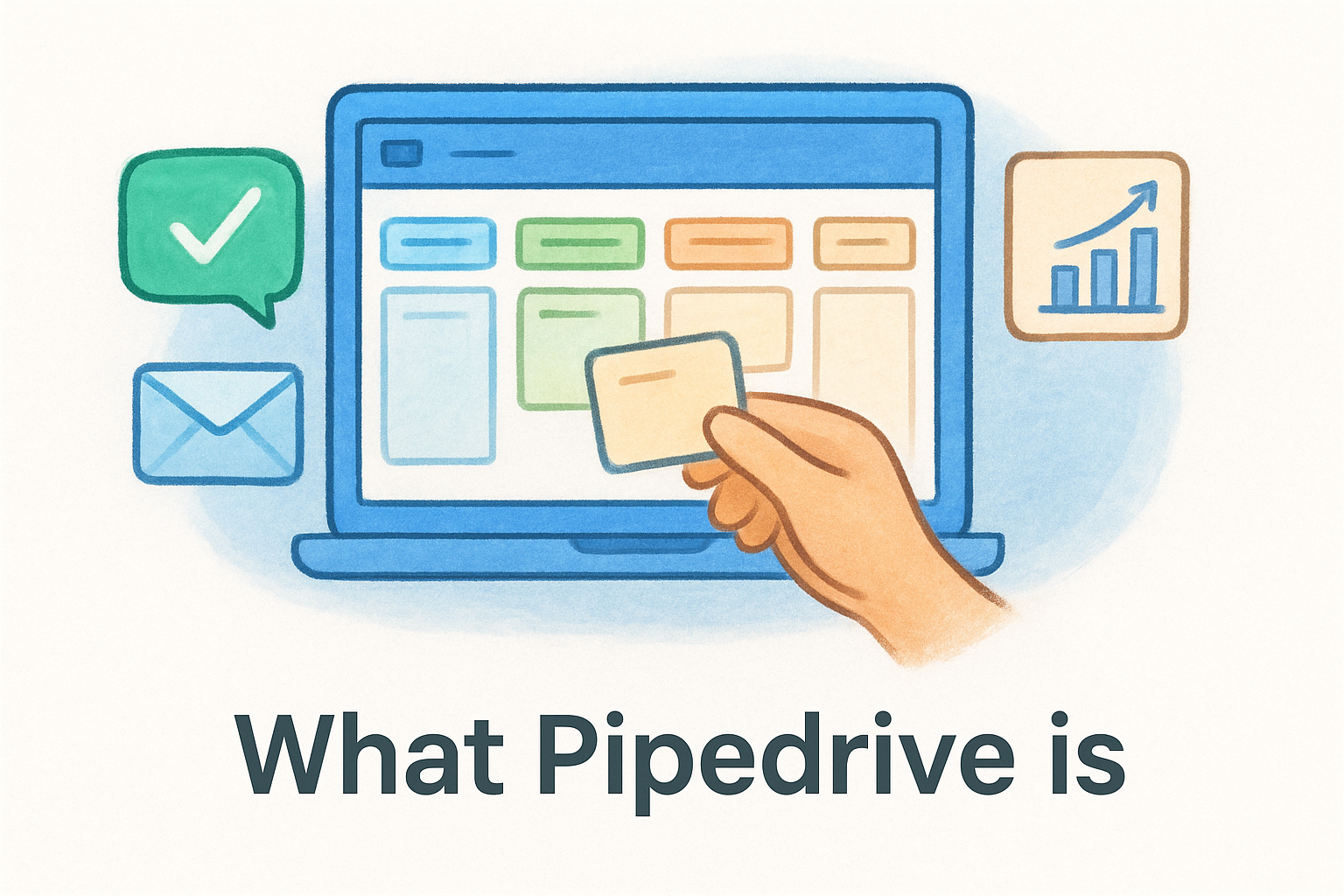
Pipedrive is a dedicated sales CRM built around pipeline management. Your team gets a visual drag-and-drop board for tracking deals, activity reminders, email sync, and performance reporting. It's designed for salespeople who want to move deals forward without managing a marketing platform on the side.
Where Pipedrive beats HubSpot
Pipedrive's pipeline interface is faster and more intuitive than HubSpot's, especially for teams that live inside their CRM every day. The activity-based selling model keeps reps focused on the next action for each deal rather than getting lost in dashboards.
For small sales teams that need a clean deal tracker, Pipedrive's interface gets out of your way faster than HubSpot's cluttered free tier.
Key advantages include:
- •Simpler onboarding, with most teams running in under a day
- •More affordable entry-level pricing for core pipeline features
Where HubSpot still wins
HubSpot covers marketing automation and sales under one roof. If your team needs email campaigns, landing pages, and ad tracking alongside CRM, HubSpot connects those tools more tightly than Pipedrive, which depends on third-party integrations for most marketing functions.
What you need to know before switching
Pipedrive has limited native marketing automation. If email sequences and campaign tracking are central to your process, you'll need add-ons or connected tools to fill those gaps, which adds cost and complexity.
Pipedrive pricing
Pipedrive starts at $14/user/month on the Essential plan. The Advanced plan at $34/user/month unlocks workflow automation and full email sync.
4. Zoho CRM
Zoho CRM is a strong contender among the best HubSpot alternatives for teams that need deep customization and a broad feature set without committing to enterprise-level pricing. It sits inside the larger Zoho ecosystem, which gives sales and operations teams a lot of tools to connect.
What Zoho CRM is
Zoho CRM is a cloud-based sales platform that covers lead management, deal pipelines, automation workflows, and reporting. The platform includes AI-powered sales assistance through its Zia feature, which surfaces predictions, anomaly detection, and conversation insights to help reps prioritize their pipeline work.
Where Zoho CRM beats HubSpot
Zoho offers significantly more customization at lower price tiers than HubSpot. You can modify modules, add custom fields, and configure multi-currency support without upgrading to a premium plan. Teams operating across multiple regions or verticals will find Zoho's flexibility easier to work with than HubSpot's more rigid structure.
For organizations already using Zoho Books, Zoho Desk, or Zoho Campaigns, the native integration across those tools creates a tighter connected stack than HubSpot's third-party alternatives at comparable spend.
Where HubSpot still wins
HubSpot delivers a cleaner, more consistent user experience across its interface. Zoho CRM's customization depth can become a liability for smaller teams, as the configuration options add complexity that requires dedicated admin time to manage well.
What you need to know before switching
Zoho's interface has a steeper learning curve than most competitors. Plan for a structured onboarding period of at least two to three weeks before your sales team operates at full speed.
Zoho CRM pricing
Zoho CRM's Standard plan starts at $14/user/month, while the Professional plan runs $23/user/month and unlocks automation, scoring rules, and inventory management.
5. Freshsales
Freshsales is a sales-focused CRM built by Freshworks, a company already known for customer support software. It belongs on any shortlist of the best HubSpot alternatives for teams that want AI-assisted selling features baked into a clean, approachable interface at a price well below HubSpot.
What Freshsales is
Freshsales is a cloud-based CRM platform that covers contact management, deal pipelines, built-in phone and email, and AI-driven sales assistance through its Freddy AI engine. The platform surfaces lead scores, next-best-action suggestions, and deal health indicators directly inside the pipeline view, so your reps don't have to dig through reports to prioritize their day.
Where Freshsales beats HubSpot
Freshsales includes built-in calling and SMS at lower price tiers than HubSpot, which charges separately for its calling features. Freddy AI also delivers predictive contact scoring without requiring an enterprise upgrade, giving smaller teams access to lead prioritization tools that HubSpot typically reserves for higher-tier plans.
If your sales team lives on the phone, Freshsales bundles calling directly into the CRM in a way that saves you a separate telephony tool.
Where HubSpot still wins
HubSpot's marketing automation suite is broader and better connected to content tools like landing pages and ad tracking. Freshsales is primarily a sales platform, and its marketing functionality feels limited in comparison for teams running full-funnel campaigns.
What you need to know before switching
Freshsales works best when your workflow centers on direct outreach and pipeline movement rather than inbound marketing. Teams that rely heavily on automated nurture sequences should verify that Freshsales' email automation covers their specific use case before committing.
Freshsales pricing
Freshsales offers a free plan for up to three users. Paid plans start at $9/user/month for the Growth tier, with the Pro plan at $39/user/month unlocking AI features and advanced automation.
6. EngageBay
EngageBay is one of the more underrated picks among the best HubSpot alternatives, particularly for small businesses that want marketing, sales, and support tools combined in a single platform without paying HubSpot-level prices.
What EngageBay is
EngageBay is an all-in-one CRM platform that covers contact management, email marketing, deal pipelines, live chat, and help desk functionality. The platform targets small businesses and startups that want a consolidated tool instead of stitching together multiple separate subscriptions to cover the same ground.
Where EngageBay beats HubSpot
EngageBay's free plan is considerably more generous than HubSpot's, offering marketing, CRM, and support features without locking core functionality behind paid tiers. You also get live chat and a help desk included at entry-level pricing, which HubSpot charges separately for through its Service Hub.
If you're running a small team that handles both sales and customer support, EngageBay gives you tools for both functions without requiring a separate platform or an upgrade.
Where HubSpot still wins
HubSpot has deeper marketing automation logic and a more established integration library. EngageBay's automation features work well for straightforward sequences, but complex multi-branch workflows with advanced conditional logic are better handled inside HubSpot's Marketing Hub.
What you need to know before switching
EngageBay works best for teams with under 15 users and relatively straightforward sales and marketing processes. Larger teams may hit limitations in reporting depth and workflow complexity as they scale, so validate those caps before fully committing.
EngageBay pricing
EngageBay offers a free plan for up to 15 users. Paid plans start at $11.99/user/month for the Basic tier, with the Growth plan running $45.99/user/month for full automation and advanced reporting access.
7. Brevo
Brevo (formerly Sendinblue) earns its spot among the best HubSpot alternatives for teams whose primary need is email marketing and transactional messaging rather than full-scale sales pipeline management. The platform has grown from a basic email tool into a multi-channel marketing suite that covers email, SMS, live chat, and basic CRM functionality.
What Brevo is
The platform is a cloud-based marketing solution centered on email campaigns, automation, and transactional email delivery. It supports contact management, landing pages, SMS marketing, and WhatsApp campaigns alongside its core email tools, giving marketing-heavy teams a broad channel mix without adding separate subscriptions.
Where Brevo beats HubSpot
Brevo's email pricing model charges based on the number of emails you send rather than the number of contacts you store. If you maintain a large contact list but only email a segment of it regularly, that structure can save you significant money compared to HubSpot's contact-based pricing.
Brevo works particularly well for e-commerce and content teams that run high-volume transactional emails alongside standard marketing campaigns.
SMS and WhatsApp campaigns are built natively into the platform at rates that undercut HubSpot's add-on pricing for the same channels.
Where HubSpot still wins
HubSpot delivers stronger sales pipeline management and deal-level reporting. Brevo's CRM handles basic contact organization well, but it won't replace a dedicated sales CRM for teams managing complex pipelines across multiple reps.
What you need to know before switching
Brevo's automation builder handles linear email sequences reliably, but multi-branch workflows across different channels take more effort to configure than HubSpot's visual workflow editor. Verify your specific automation requirements match what Brevo supports before you fully commit.
Brevo pricing
Brevo's free plan includes unlimited contacts and up to 300 emails per day. Paid plans start at $9/month for the Starter tier, priced on monthly email volume rather than user count.
8. GetResponse
Among the best HubSpot alternatives for teams that build growth around email marketing and webinar-driven sales funnels, GetResponse has built a strong reputation. The platform has expanded well beyond its email roots into a full marketing suite with automation, landing pages, and conversion tools that connect lead capture directly to your campaign workflows.
What GetResponse is
GetResponse is a cloud-based marketing platform that covers email campaigns, automation workflows, landing pages, webinars, and basic CRM contact management. Its conversion funnel builder connects lead capture, email nurturing, and sales pages into a single visual flow, making it practical for teams running structured marketing pipelines without a dedicated developer.
Where GetResponse beats HubSpot
GetResponse includes native webinar hosting at mid-tier pricing, a feature HubSpot doesn't offer at any plan level without a third-party integration. For teams that generate leads through live or recorded webinars, that native connection between your webinar platform and your email list removes a painful integration step.
If webinars are a key part of your lead generation strategy, GetResponse eliminates the tool-switching that comes with running separate webinar software alongside your CRM.
Where HubSpot still wins
HubSpot provides stronger sales pipeline management and deal-level reporting for sales-focused teams. GetResponse is primarily built around marketing workflows, so reps managing complex multi-stage deals will find the CRM side limited compared to what HubSpot offers.
What you need to know before switching
GetResponse works best for marketing-led teams rather than outbound sales organizations. Before migrating your existing workflows, verify that its automation logic and contact segmentation cover your specific campaign requirements.
GetResponse pricing
The platform offers a free plan for up to 500 contacts. Paid plans start at $19/month for the Email Marketing tier, with the Marketing Automation plan at $59/month unlocking full workflow automation and webinar hosting.
9. Omnisend
Omnisend is a specialized marketing automation platform built primarily for e-commerce businesses. It connects directly to online stores and lets you trigger campaigns based on shopper behavior, product activity, and purchase history, making it a practical pick for retail-focused teams looking for an alternative to HubSpot's broader, less commerce-specific toolset.
What Omnisend is
Omnisend is a cloud-based marketing platform designed around e-commerce workflows. It covers email campaigns, SMS, push notifications, and automation sequences that fire based on real-time customer actions like abandoned carts, product views, and order completions. The platform integrates natively with Shopify, WooCommerce, and BigCommerce, pulling product data directly into your campaigns without manual setup.
Where Omnisend beats HubSpot
Omnisend's e-commerce automation templates are pre-built around the specific events that drive retail revenue, abandoned cart recovery, post-purchase follow-ups, and win-back sequences. HubSpot requires more manual configuration to replicate those flows, and the results are rarely as tight without custom development work.
For online store owners, Omnisend's native product blocks and commerce triggers reduce setup time dramatically compared to building equivalent workflows inside HubSpot.
Where HubSpot still wins
HubSpot provides stronger B2B sales pipeline management and broader CRM functionality for teams that aren't running online stores. Omnisend's contact management and deal-tracking capabilities fall well short of what HubSpot offers for sales-led organizations.
What you need to know before switching
Omnisend's value is highly dependent on your store platform. If you're not running an e-commerce operation on a supported platform, the core functionality loses much of its advantage over general-purpose tools.
Omnisend pricing
Omnisend offers a free plan for up to 250 contacts. Paid plans start at $16/month for the Standard tier, with pricing scaling based on contact count.
10. Drip
Drip is a marketing automation platform built around e-commerce businesses that want more control over customer journeys than general-purpose CRMs typically offer. It sits among the best HubSpot alternatives for online retailers who need behavior-triggered campaigns tied directly to purchase data.
What Drip is
Drip is a cloud-based email and SMS marketing platform designed specifically for e-commerce brands. It pulls purchase history, browsing behavior, and cart activity from your store to power personalized automation workflows that respond to what your customers actually do, not just what list they're on.
Where Drip beats HubSpot
Drip's e-commerce segmentation goes deeper than HubSpot's out of the box. You can filter contacts by purchase frequency, average order value, and product category without custom field workarounds or expensive add-ons. That precision gives your campaigns a tighter connection to actual buying behavior.
For e-commerce teams running multi-step post-purchase sequences, Drip's revenue attribution reporting shows exactly which automation flows are generating income.
Where HubSpot still wins
HubSpot delivers stronger B2B sales pipeline management with deal tracking, activity logging, and rep-level reporting that Drip simply doesn't cover. Teams running outbound sales alongside marketing will find Drip too narrow for their full workflow needs.
What you need to know before switching
Drip works best when your primary revenue channel is e-commerce. If you're running a service-based business or a traditional B2B sales process, the platform's store-centric feature set won't fully match your operational requirements.
Drip pricing
Drip starts at $39/month for up to 2,500 contacts, with pricing scaling based on contact list size. There are no user seat limits at any tier.
11. Ontraport
Ontraport is a business automation platform that earns its place among the best HubSpot alternatives for service-based businesses, coaches, consultants, and course creators who need marketing automation and CRM tightly connected in a single system.
What Ontraport is
Ontraport is a cloud-based business automation platform that combines CRM, email marketing, landing pages, membership sites, and payment processing into one tool. It's built for small businesses running complex customer journeys that involve multiple touchpoints, payment events, and personalized follow-up sequences rather than straightforward linear pipelines.
Where Ontraport beats HubSpot
Ontraport includes native payment processing and membership site management, features that HubSpot doesn't offer without connecting third-party tools. If your business sells digital products, courses, or subscription services, that built-in commerce layer saves you significant integration work.
For service businesses that need to trigger automations based on payment events, Ontraport handles that natively while HubSpot requires external workarounds.
Where HubSpot still wins
HubSpot has a broader integration library and stronger brand recognition across B2B sales teams. Its pipeline reporting and deal management features are also more developed for organizations running traditional outbound sales processes with multiple reps tracking opportunities simultaneously.
What you need to know before switching
Ontraport's interface has a noticeable learning curve, and new users typically spend two to four weeks getting fully comfortable with the automation builder. You should also confirm that Ontraport's contact and email limits at your target tier fit your current list size before committing to a migration.
Ontraport pricing
Ontraport starts at $24/month for the Basic plan, which covers one user and up to 500 contacts. The Plus plan runs $83/month and increases contact limits alongside automation capabilities.
12. Salesforce
Salesforce is the largest CRM platform in the world by market share, and it shows up on lists of the best HubSpot alternatives from a different angle than most other tools here. Rather than competing on simplicity or price, it competes on depth, configurability, and enterprise scalability.
What Salesforce is
Salesforce is a cloud-based CRM and business platform that covers sales, service, marketing, and analytics across a massive ecosystem of products and integrations. Tens of thousands of organizations run their entire revenue operation on it, from small sales teams to multinational corporations with hundreds of reps across multiple regions.
Where Salesforce beats HubSpot
Salesforce offers far deeper customization and reporting capabilities than HubSpot at the enterprise level. Its pipeline management handles complex, multi-stage deal structures with custom objects, approval processes, and territory management that HubSpot can't match without significant workarounds or third-party tools.
If your sales process involves complex pricing approvals, multi-region teams, or deeply custom data models, Salesforce handles that infrastructure better than any other platform.
Where HubSpot still wins
HubSpot is considerably easier to set up and use for teams without dedicated CRM administrators. Salesforce implementations often require months of configuration and ongoing admin support, which adds real cost on top of licensing fees that already start well above HubSpot.
What you need to know before switching
Salesforce is not a budget move. Implementation costs, admin salaries, and add-on licensing can push total annual spend well past HubSpot even when the base pricing looks competitive. Validate your internal technical capacity before committing.
Salesforce pricing
Salesforce's Starter Suite begins at $25/user/month, but most teams land on the Pro Suite at $100/user/month or higher once they add necessary features and integrations.
13. Close
Close is a sales-focused CRM built specifically for inside sales teams that do a high volume of outreach through calls and emails. It stands out among the best HubSpot alternatives because everything in the platform is designed around one goal: helping your reps make more contact and close more deals faster.
What Close is
Close is a cloud-based CRM centered on built-in calling, SMS, and email sequences. The platform gives your team a single workspace where they can dial contacts, send follow-up emails, and track every touchpoint without switching between separate tools. Pipeline management and activity tracking sit inside the same view your reps use for outreach, which keeps the workflow tight.
Where Close beats HubSpot
Close includes native power dialing and call recording at pricing tiers where HubSpot charges separately for calling features. Your reps can move through a call list directly inside the CRM without a third-party integration. The email sequence builder is also faster to set up than HubSpot's sequences, with less configuration required to get a campaign running.
For inside sales teams running high outreach volume, Close reduces the tool-switching that slows reps down in HubSpot's more fragmented interface.
Where HubSpot still wins
HubSpot offers broader marketing automation and stronger inbound tools like landing pages and ad management. Close focuses exclusively on sales execution, so teams that run combined marketing and sales workflows will find significant feature gaps on the marketing side.
What you need to know before switching
Close works best for outbound-heavy sales teams rather than marketing-led organizations. If your pipeline relies on inbound nurturing sequences, verify that Close's automation covers your needs before migrating.
Close pricing
Close starts at $49/month for the Startup plan covering one user, with the Professional plan at $99/user/month unlocking power dialing and advanced reporting.
14. Monday CRM
Monday CRM brings a visual, highly customizable workspace to sales pipeline management, making it a practical consideration among the best HubSpot alternatives for teams that already work inside Monday.com's broader project management ecosystem.
What Monday CRM is
The platform is a cloud-based CRM layer built on top of Monday.com's flexible work OS. It gives sales teams customizable pipeline boards, contact tracking, and deal management inside the same visual interface used for project and task management. You can configure your CRM layout to match your actual workflow without requiring any developer support.
Where Monday CRM beats HubSpot
Its interface flexibility is genuinely hard to match at comparable price points. You can build custom views, automate status changes, and connect your CRM data to project boards in a way that keeps your entire team aligned. For companies running sales and operations on a shared platform, that unified workspace reduces the tool-switching that slows reps down.
If your team already uses Monday.com for project management, adding the CRM layer creates a connected workspace without onboarding everyone to an entirely new tool.
Where HubSpot still wins
HubSpot offers deeper marketing automation and email campaign tools than Monday CRM provides. Dedicated sales features like built-in email sequences and lead scoring are more developed inside HubSpot, which gives marketing-led sales teams more out-of-the-box functionality without additional configuration.
What you need to know before switching
Monday CRM works best when your organization already uses Monday.com across other departments. Standalone CRM buyers may find the platform's project management roots add unnecessary interface complexity to what should be a straightforward sales workflow.
Monday CRM pricing
The Basic plan starts at $12/user/month, with the Standard plan at $17/user/month unlocking automation and integrations.
15. Keap
Keap, formerly known as Infusionsoft, rounds out this list of the best HubSpot alternatives as a solid option for small business owners who need CRM, email automation, and basic e-commerce functionality in a single platform without managing separate tools for each function.
What Keap is
Keap is a cloud-based CRM and marketing automation platform designed specifically for small businesses running client-based or service-driven operations. It combines contact management, automated follow-up sequences, appointment scheduling, invoicing, and payment collection in one workspace, which gives small teams a more connected day-to-day operating environment than stitching together multiple standalone tools.
Where Keap beats HubSpot
Keap includes native invoicing and payment collection at pricing levels where HubSpot requires a third-party integration or a higher-tier plan to replicate the same functionality. For service businesses that collect payments directly from clients, that built-in capability saves real time and removes a friction point from your sales close process.
If you run a client services business and need to go from CRM contact to paid invoice without leaving the platform, Keap handles that loop more cleanly than HubSpot does at comparable price points.
Where HubSpot still wins
HubSpot provides stronger pipeline reporting and a more scalable CRM structure for teams adding headcount. Keap's interface and automation logic work well for smaller operations but tend to show limitations as team size and workflow complexity grow beyond the small business range it was built for.
What you need to know before switching
Keap works best for solo operators and teams under 10 users running service-based businesses. Before committing, verify that its automation capabilities cover your specific follow-up and campaign requirements.
Keap pricing
Keap starts at $299/month for up to two users, with additional users billed at $29/user/month beyond that base seat count.
What to do next
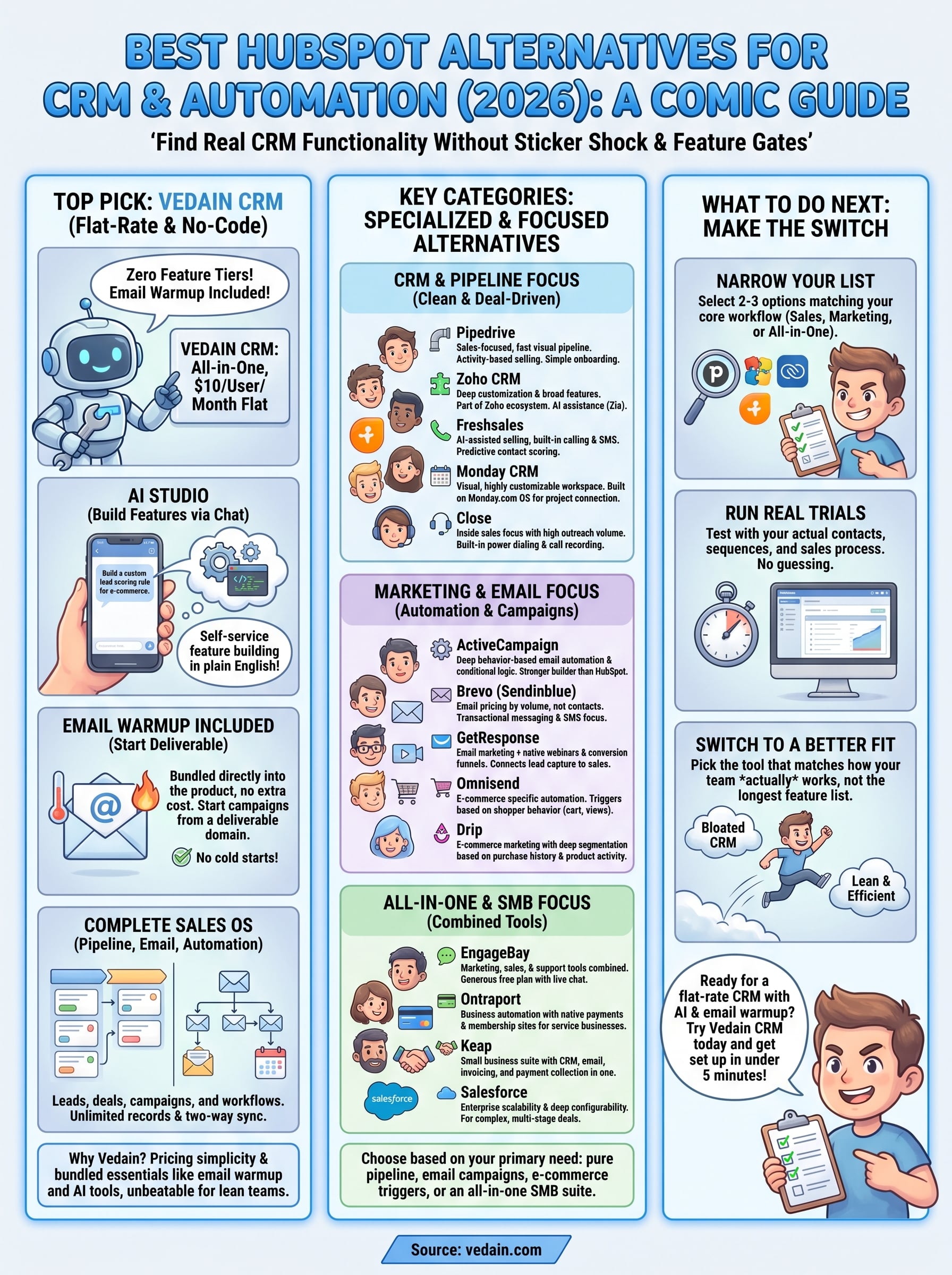
You've now seen 15 of the best HubSpot alternatives across CRM, sales automation, email marketing, and e-commerce. Each platform solves a specific problem, whether that's cutting costs, simplifying your pipeline, or consolidating tools your team already uses. The right pick depends on what your team actually does every day, not which tool has the longest feature list.
Start by narrowing your list to two or three options that match your primary workflow. Then run a real trial with your actual contacts, your actual sequences, and your actual sales process before you commit. Most platforms on this list offer free trials, so there's no reason to guess.
If you're looking for a flat-rate CRM that covers pipeline management, email automation, AI tools, and email warmup without feature gates or surprise charges, try Vedain CRM free today and have your team running in under five minutes.