We built Vedain CRM around this exact problem, all features included at $10/user/month, no tiers, no surprise invoices when you turn on email sync or automation. But we also know we're not the only option worth considering, and the right CRM depends on your team's specific workflow.
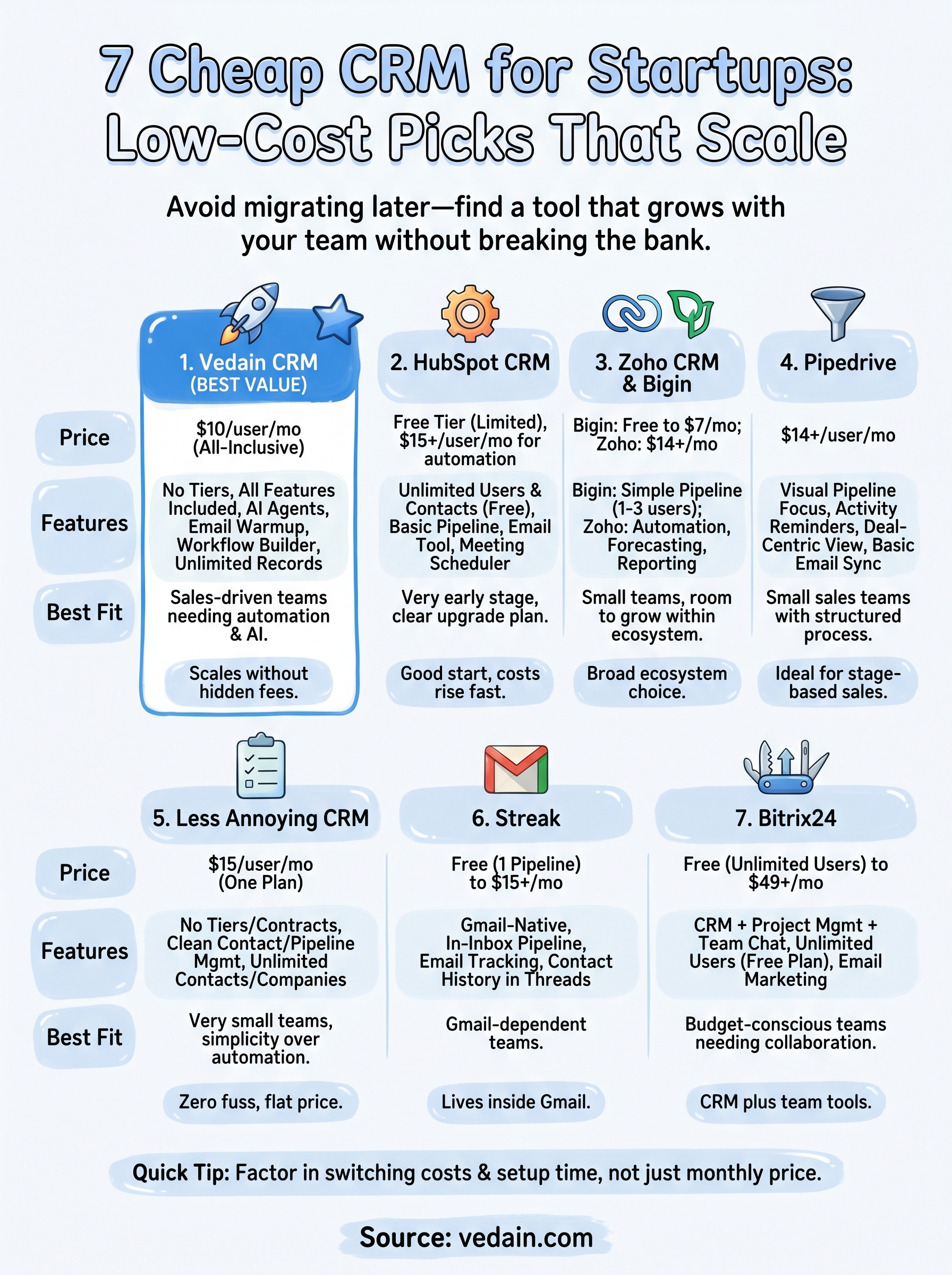
So here are seven low-cost CRM platforms that give startups real functionality at prices that make financial sense. For each one, we'll break down pricing, standout features, and where it fits best, so you can compare them side by side and pick the tool that actually matches how your team sells.
1. Vedain CRM
Vedain gives startups a complete sales operating system for a flat $10 per user per month, with no feature tiers and no paywalls. Every tool on the platform, from email sync to workflow automation to AI agents, is available from day one without unlocking a higher plan.
What you get for the price
At $10/user/month, you get access to every feature Vedain offers, which is rare in the CRM market. That covers two-way email sync with Gmail and Outlook, a no-code workflow builder, email campaigns with multi-step sequences, lead capture forms, custom dashboards, and a full AI agent marketplace with 30+ pre-built agents for data enrichment and content generation. Unlimited records are included, so you won't hit a contact cap the moment your pipeline starts growing.
Unlike most platforms that lock automation or email tools behind higher tiers, Vedain includes everything at its base price with no hidden fees.
Standout features for early-stage teams
Email warmup stands out as something most cheap CRM for startups options skip entirely. Vedain runs a 21-day domain warmup process that improves deliverability before your team sends its first campaign. On top of that, AI Studio lets you build custom CRM features by describing what you need in plain English, which matters when your team's sales process doesn't fit a rigid default template.
Other features early-stage teams find useful:
- •Visual Kanban pipeline for deal and opportunity tracking
- •LinkedIn automation for scheduling AI-generated posts
- •Sales targets for monthly and quarterly goal monitoring
- •Team leaderboards inside the Reports and Analytics module
Trade-offs to consider
Vedain is a newer platform, so its third-party integration library is still expanding compared to more established tools. If your current tech stack relies on niche integrations, check compatibility before committing to avoid friction during onboarding.
Best fit for
Vedain suits sales-driven startups that want automation, email tools, and AI capabilities without paying separately for each feature. It's a strong pick if your team runs on Gmail or Outlook and values quick setup, since the platform takes under five minutes to configure with no credit card required for the trial.
Pricing snapshot
2. HubSpot CRM
HubSpot offers a free CRM tier that appeals to many startups looking for a recognizable name at no initial cost. The free plan covers contact management, deal tracking, and a basic email tool, but the limitations become apparent quickly as your team scales or needs more advanced functionality.
What you get for the price
The free tier gives you unlimited users and up to 1 million contacts, which sounds generous on paper. In practice, features like email sequences, automation, and advanced reporting are gated behind paid plans that start at $15/user/month for Starter and climb significantly from there.
Standout features for early-stage teams
If you're just getting started, HubSpot's free pipeline and contact management covers the basics cleanly. The interface is polished, the learning curve is low, and the built-in meeting scheduler reduces back-and-forth when booking demos with prospects.
Trade-offs to consider
This is where HubSpot gets costly. As a cheap crm for startups, the free plan works until your team needs automation or multi-step email sequences, at which point costs escalate fast. Custom properties and detailed reporting are also paywalled, which pushes many startups to upgrade sooner than planned.
The free plan is a useful starting point, but budget carefully before committing if your team depends on automation or sequences.
Best fit for
HubSpot fits very early-stage teams that need basic pipeline visibility and aren't ready to pay yet, but have a clear plan to upgrade once revenue supports it.
Pricing snapshot
3. Zoho CRM and Bigin
Zoho offers two products worth comparing as a cheap crm for startups: Zoho CRM for teams that need full sales functionality, and Bigin, a pipeline-focused tool built for smaller teams with simpler processes. Picking the right one depends on how complex your sales workflow is today and how fast you expect it to grow.
What you get for the price
The free Zoho CRM plan supports up to three users with basic lead, contact, and deal management included. Bigin's free plan covers one user with a single pipeline and 500 records. Paid plans start at $7/user/month for Bigin and $14/user/month for Zoho CRM Standard, which unlocks email templates, custom reports, and scoring rules.
Standout features for early-stage teams
Bigin keeps things clean with a pipeline-first interface that takes minutes to configure, which helps if your team finds full CRM platforms overwhelming at first. Zoho CRM's paid tiers add workflow automation and sales forecasting, giving growing teams more structure as their process matures.
If your startup needs a lightweight tool now but plans to scale, starting on Bigin and migrating to Zoho CRM later is a realistic path within the same product ecosystem.
Trade-offs to consider
Zoho's product lineup is broad, which creates confusion when choosing between tools upfront. Teams on lower-tier plans also report that customer support response times are inconsistent, which can slow you down during onboarding.
Best fit for
Zoho suits small teams that need a proven, low-cost platform with room to grow without switching vendors down the line.
Pricing snapshot
4. Pipedrive
Pipedrive is a sales-focused CRM built around pipeline management, making it a solid pick for startups that want deal-centric visibility from day one. The interface centers on moving deals through stages, which suits teams that think in terms of active opportunities rather than contact databases.
What you get for the price
Pipedrive's Essential plan starts at $14/user/month and covers one pipeline, basic deal management, and email integration. The Advanced plan at $29/user/month unlocks email sequences and workflow automation, which is where the platform becomes genuinely useful for a growing sales team.
Standout features for early-stage teams
The visual pipeline view is Pipedrive's strongest asset. It's clean, fast, and requires almost no training to navigate. Your reps also get activity-based reminders that prompt follow-ups on stalled deals, reducing the chance that warm opportunities go cold without anyone noticing.
Pipedrive's deal-focused design works best for teams running a structured, stage-based sales process rather than high-volume outbound.
Trade-offs to consider
As a cheap crm for startups, Pipedrive's entry plan is limiting. You won't get email automation or meaningful reporting depth without upgrading, and costs scale up quickly across even a small team once you add the features that make the platform worth using.
Best fit for
Pipedrive fits small sales teams with a defined pipeline process who prioritize deal tracking over contact volume or built-in marketing tools.
Pricing snapshot
5. Less Annoying CRM
Less Annoying CRM takes a deliberately simple approach to sales software, offering a flat $15/user/month with no tiers, no annual contracts, and no feature gates. For startups that want a no-fuss tool built around contact and pipeline management, it delivers exactly what the name promises.
What you get for the price
At $15/user/month, you get the full feature set: contact management, a customizable pipeline, task tracking, calendar integration, and a basic reporting dashboard. There is only one plan, so you won't spend time comparing tiers or worrying about which features your budget actually unlocks.
Standout features for early-stage teams
The contact and lead management interface is one of the cleanest available at this price point. Less Annoying CRM also gives you unlimited contacts and companies from day one, removing the record caps that make other cheap crm for startups tools frustrating as your pipeline scales.
If your team has struggled with overly complex platforms, this stripped-down design can meaningfully cut the time your reps spend on admin work.
Trade-offs to consider
The platform skips workflow automation entirely, so you won't find a sequence builder or automated follow-up tools here. If your sales process depends on multi-step outreach, this tool will hit its limits fast.
Best fit for
Less Annoying CRM works best for very small teams that need clean contact and pipeline tracking without automation or a steep learning curve.
Pricing snapshot
6. Streak
Streak runs directly inside Gmail, which makes it a different kind of CRM from every other tool on this list. Instead of switching between tabs, your team manages contacts, pipelines, and email tracking from within the inbox they already use every day.

What you get for the price
Streak's free plan supports unlimited users with basic pipeline management and email tracking built into Gmail. The paid Solo plan starts at $15/user/month and adds more pipelines, mail merge, and reporting. The Pro plan at $49/user/month unlocks team features and advanced permissions.
Standout features for early-stage teams
The Gmail-native design is Streak's biggest differentiator. Your reps see pipeline stages, contact history, and deal notes right alongside their email threads, which cuts the friction of logging activity manually. Email tracking that shows when a prospect opens your message is included even on lower-tier plans, giving your team timely signals for follow-up.
If your entire sales workflow runs through Gmail, Streak removes the context-switching that slows most reps down.
Trade-offs to consider
Streak works well only if your team is fully committed to Gmail. It offers no meaningful value for Outlook users, and the free plan limits you to a single pipeline, which becomes a constraint as your sales process grows more complex.
Best fit for
Streak fits Gmail-dependent teams that want pipeline visibility without leaving their inbox and aren't ready to commit to a standalone cheap crm for startups platform.
Pricing snapshot
7. Bitrix24
Bitrix24 combines CRM, project management, and team communication in one platform. Its free plan is among the most generous on this list, but the sheer volume of features can work against you if all you need is a focused sales tool.
What you get for the price
Bitrix24's free plan supports unlimited users and includes contact management, a basic pipeline, email marketing, and task tracking at no cost. Paid plans start at $49/month for the Basic plan (up to 5 users), which makes per-user pricing harder to compare against most alternatives on this list.
Standout features for early-stage teams
The free plan's unlimited user allowance is genuinely rare at this price point, giving your full sales team room to get in without paying anything upfront. Bitrix24 also includes built-in team messaging and project management, which reduces the number of separate subscriptions your startup needs day to day.
If your startup needs CRM and internal communication in a single tool, Bitrix24's free plan covers more ground than most cheap crm for startups options at zero cost.
Trade-offs to consider
The platform's breadth creates real complexity. New users frequently report a steep learning curve because the interface surfaces too many tools at once. Customer support on the free tier is also limited, which can slow your team during initial setup.
Best fit for
Bitrix24 works best for budget-conscious startups that need CRM alongside team collaboration tools and are willing to invest time learning the platform.
Pricing snapshot
Quick next step
Every tool on this list solves a real problem, but they solve different ones. If your startup needs basic pipeline visibility at no cost, HubSpot or Streak cover the essentials until revenue supports a paid plan. If you want automation, email tools, and AI features without paying separately for each one, Vedain is worth a serious look.
Picking the right cheap crm for startups comes down to where your team sells today and what you'll need six months from now. A free plan that forces you to migrate in three months isn't actually cheap. Factor in switching costs and setup time when you compare options, not just the monthly per-seat price.
If Vedain fits what you're looking for, you can get started in under five minutes with no credit card required. Try Vedain CRM and see how it fits your sales process.