The difference between teams that consistently hit quota and those that don't usually comes down to how they structure, monitor, and act on their pipeline. A well-managed pipeline exposes bottlenecks early, keeps reps focused on winnable deals, and gives managers the visibility they need to coach effectively. Without that structure, even talented salespeople end up spinning their wheels on deals that were never going to close.
At Vedain CRM, we built our platform around this exact challenge, giving sales teams a visual pipeline, built-in automation, and real-time analytics at $10/user/month with every feature included. We've watched hundreds of teams transform their sales process with the right practices in place. This article breaks down nine proven strategies to help you manage your pipeline with more precision, close deals faster, and stop leaving revenue on the table.
1. Run your pipeline in Vedain CRM
Every best practice in this article depends on one thing: a centralized place where your entire team works from the same data. Vedain CRM gives you that foundation with a visual pipeline, built-in automation, and real-time analytics all in one place at $10 per user per month, with every feature included and no hidden upgrades.
Why a single source of truth matters for pipeline health
When reps track deals in spreadsheets, inboxes, and personal notebooks, your pipeline data is always incomplete. Managers can't see what's real, forecasts become guesswork, and deals fall through gaps nobody notices until it's too late. Centralizing everything in Vedain CRM means every deal, contact, and activity lives in one place your whole team can access, update, and act on with confidence.
A single source of truth is not a nice-to-have. It's the foundation every other sales pipeline management best practice depends on.
The Vedain CRM features that support pipeline management
Vedain gives you a visual Kanban board to track deals by stage, two-way email sync with Gmail and Outlook, and a no-code workflow builder to automate repetitive tasks. You also get built-in pipeline reports, conversion funnels, and team leaderboards so you can spot bottlenecks without building reports from scratch. Every one of these features ships at the same flat rate with no tier restrictions.
A fast setup checklist for stages, fields, and views
Getting Vedain configured takes under five minutes. Start by mapping your existing sales stages to the pipeline board, then add custom fields for the deal data your team needs to capture at each step. Next, create a default view filtered by owner, stage, and close date so every rep opens the CRM and immediately sees their priority deals. Finish by inviting your team and setting module-level permissions before your next sales meeting.
Signs you have outgrown spreadsheets and scattered tools
If your team spends more than 15 minutes before a sales meeting pulling together deal status updates, you have a data problem, not a preparation problem. Additional warning signs include reps using personal inboxes to track follow-ups, managers relying on verbal updates to understand pipeline health, and deals closing without any record of what drove the decision. These patterns signal that a purpose-built CRM is no longer optional for your team.
2. Define clear pipeline stages and exit criteria
A pipeline with vague or misaligned stages is almost as bad as no pipeline at all. When reps interpret stages differently, your pipeline data loses its meaning and your forecasts become unreliable before they even reach a manager's desk.
How to choose stages that match your real sales process
Your stages should reflect what actually happens in your sales cycle, not what sounds good in a template. Start by mapping the real steps your best-won deals followed from first contact to closed, then build stages around those buyer-driven milestones rather than internal activities like "rep follow-up" or "proposal sent."
How to write entry and exit criteria reps can follow
Entry and exit criteria turn stage names into clear, actionable checkpoints every rep can apply without interpretation. For each stage, define what must be true for a deal to enter and what must be confirmed before it advances, such as a verified budget range or a scheduled technical review with the key decision-maker.

Exit criteria are what keep your pipeline honest and your forecast grounded in evidence rather than optimism.
How to set stage aging limits and required fields
Each stage needs a maximum number of days before a deal is flagged as stale and reviewed. Pair those limits with required fields that reps must complete before advancing a deal, so critical details like timeline, deal size, and decision-maker name never get skipped under pressure.
How to keep stage definitions consistent across teams
Document your stage definitions in a shared location and revisit them during onboarding for every new rep. When definitions drift between team members, your reporting breaks down and managers lose the ability to compare performance or spot real bottlenecks in the sales pipeline management best practices your team depends on.
3. Qualify deals with a consistent framework
Filling your pipeline with unqualified deals corrupts your forecast and exhausts your reps. Consistent qualification is central to any effective set of sales pipeline management best practices because it keeps your team focused on deals that can actually close.
What great qualification looks like in practice
Great qualification happens early and repeatedly, not just on the first call. Strong reps validate fit, budget, timeline, and decision-making authority at each stage rather than assuming those details stay fixed as the deal matures.
Weak qualification typically shows up as deals that stay active for weeks without a confirmed budget or a named decision-maker. If your reps can't answer those two questions after the second conversation, the deal is not yet real.
The core questions that uncover fit, pain, and urgency
Ask these questions before a deal advances past the discovery stage:
- •What specific problem is the buyer trying to solve, and what is it costing them now?
- •Who controls the budget, and what is the approved spending range?
- •What happens internally if they do nothing before their target date?
- •Who else has a say in the final purchase decision?
The reps who qualify hardest early spend the least time chasing deals that will never close.
How to capture qualification in deal fields and notes
Build your CRM fields around the answers you need, not just the questions you ask. Map each qualification criterion to a dedicated deal field so managers can filter by data completeness instead of relying on rep memory or buried call notes.
When to disqualify fast and how to do it cleanly
When a deal fails two or more qualification criteria, remove it from your active pipeline immediately. Log a disqualification reason in a structured field so your team can identify patterns across dead deals and tighten your ideal customer profile over time.
4. Keep your pipeline clean with weekly hygiene rules
Pipeline hygiene is one of the most overlooked sales pipeline management best practices, yet it has a direct impact on forecast accuracy. When stale deals mix with active opportunities, reps lose focus and managers make decisions based on numbers that don't reflect reality.
What makes a deal stale and why it hurts forecasting
A deal becomes stale when no meaningful activity has occurred within its expected stage window. These deals inflate your total pipeline value and push your forecast above where it should realistically land, setting up a painful miss at the end of the quarter.
A pipeline that reflects reality is more valuable than a large pipeline built on outdated assumptions.
A weekly hygiene routine for reps and managers
Every week, reps should review open deals and update close dates, stage positions, and next steps based on actual conversations. Managers should filter by deals with no activity in the last 7 to 14 days and flag those before the team call.
A simple weekly checklist keeps this routine consistent:
- •Archive deals with no contact in 30 or more days
- •Update the stage for any deal that has advanced since the last review
- •Log a concrete next step for every deal still marked active
How to use email and activity history to keep data current
Your two-way email sync surfaces recent touches automatically so reps spend less time on manual logging. Use that activity history to confirm which deals have real momentum and which ones have gone quiet without a formal close-out.
Common pipeline hygiene mistakes and how to prevent them
The most common mistake is letting reps push close dates forward without a required re-qualification step. Set a rule that any deal with a repeatedly moved close date triggers an immediate manager review to confirm it still belongs in the active pipeline.
5. Track the few metrics that predict revenue
Tracking every metric available is one of the fastest ways to lose focus on what actually drives results. Sales pipeline management best practices point to a short list of numbers that give you reliable early signals before the quarter ends.
Pipeline coverage ratio and how to set a realistic target
Your pipeline coverage ratio compares total open pipeline value to your revenue target for the period. Most teams aim for a 3x to 4x ratio, meaning if your quarterly target is $100,000, you want $300,000 to $400,000 in active deals to account for deals that will stall or be lost along the way.
A coverage ratio below 2x is a warning sign that you need to generate more opportunities before you can fix anything else.
Stage conversion rates and how to spot bottlenecks
Measure the percentage of deals that advance from each stage to the next. A sharp drop at a specific transition, such as discovery to proposal, tells you exactly where your process breaks down so you can address it with coaching or a process change rather than guessing.
Pipeline velocity and what to change when it slows
Pipeline velocity measures how quickly deals move through your pipeline and combines deal count, average deal size, win rate, and cycle length into a single number. When velocity drops, break it into those four components to identify which variable is dragging performance down.
Win rate, deal size, and cycle length by segment
Segment these three metrics by industry, company size, and lead source to find where your team performs best. Deals from one segment may close twice as fast at a higher average value, which should directly shape where your reps spend their prospecting time.
6. Build a follow-up cadence you can actually stick to
Inconsistent follow-up kills more deals than bad pitches. One of the most practical sales pipeline management best practices is designing a cadence your reps will actually execute, not an elaborate sequence that collapses the moment a rep gets busy.
How to map touches to stages and buyer behavior
Your follow-up frequency should match where a buyer sits in your pipeline and how engaged they have been. Early-stage prospects need more frequent outreach across multiple channels, while later-stage deals benefit from fewer, more deliberate touches that move toward a specific decision.
How to use sequences without sounding robotic
Build your sequences around real context from previous conversations rather than generic templates. Reference the problem the buyer mentioned, the timeline they shared, or the next step you agreed on. A sequence that feels personal gets opened; a generic drip gets ignored.
The best follow-up cadences feel like a logical continuation of a conversation, not a scheduled interruption.
How to improve reply rates with timing and relevance
Send follow-ups Tuesday through Thursday between 8 a.m. and 10 a.m. in the buyer's time zone. Pair timing with relevance by attaching a specific reason for reaching out, such as a relevant case study, a question tied to their stated goal, or a brief summary of what you discussed on the last call.
Lead response time for inbound leads and how to tighten it
Inbound leads convert at a dramatically higher rate when contacted within five minutes of submitting a form. Set an automated task trigger in your CRM the moment a lead form is filled so the assigned rep gets an immediate notification with the lead's details ready to act on.
7. Shorten the sales cycle with next-step discipline
A long sales cycle is often a symptom of vague commitments and conversations that end without a clear direction. One of the most underrated sales pipeline management best practices is building a habit where every interaction closes with a defined, time-bound next step that both sides agree to before the call ends.
How to set a concrete next step on every interaction
Before you end any call or meeting, confirm a specific action and a confirmed date with the buyer. "I'll follow up next week" is not a next step. "We'll meet Thursday at 2 p.m. to review the proposal with your CFO" is. When both sides commit to something tangible, deals keep moving instead of drifting into silence.
A deal without a confirmed next step is not an active deal, it is a wish.
How to keep deals moving with stakeholders and milestones
Map out all key stakeholders and decision points early in the sales process. When you know who signs, who evaluates, and who can block a deal, you can build a sequence of milestone-based check-ins that pull the right people into the conversation at the right time instead of scrambling near the close.
How to reduce friction in pricing, legal, and procurement
Identify the internal approval steps your buyer faces and get ahead of them. Share pricing summaries, compliance documentation, or contract templates early so legal and procurement teams are not starting from scratch when the deal reaches them.
How to use the right sales content to unblock decisions
Send targeted case studies or ROI summaries when a deal stalls at a specific objection. Content that speaks directly to the buyer's industry and stated concern removes hesitation faster than a follow-up call asking where things stand.
8. Automate repetitive work with workflows and sequences
Manual follow-up reminders, data entry, and internal handoffs consume hours your reps could spend in actual sales conversations. Automation is one of the most scalable sales pipeline management best practices because it eliminates repetitive low-judgment work without removing the human judgment that closes deals.
What to automate first for the biggest time savings
Start with the highest-frequency tasks your reps repeat on every single deal: logging activity after meetings, sending confirmation emails after stage changes, and creating follow-up tasks when a deal goes quiet. Prioritize these three categories before building anything more complex:
- •Activity logging triggered by calls or meetings
- •Confirmation emails sent automatically after stage advances
- •Overdue deal alerts pushed to managers when aging limits are hit
How to trigger tasks and messages from stage changes
Set up stage-based triggers that fire automatically when a deal moves to a new stage. When a deal enters your proposal stage, trigger a rep task to send a pricing summary. When it closes, trigger an internal notification to onboarding so the handoff requires no manual coordination.

Automating stage-based triggers removes the coordination lag that quietly slows deals between teams.
How to build no-code workflows for handoffs and approvals
Vedain's no-code workflow builder lets you design multi-step automations using plain conditions and actions, with no developer required. Map each handoff checkpoint between sales, legal, and onboarding as a discrete workflow step so nothing slips through when a deal changes hands.
How to keep automation personal, accurate, and compliant
Every automated message should pull dynamic deal fields like the buyer's name, company, and product interest so each touchpoint feels specific rather than generic. Review your sequences quarterly to confirm that contact data stays accurate and that your outreach complies with current email regulations.
9. Run pipeline reviews that improve forecasting
Pipeline reviews are where your sales pipeline management best practices hold together or break down. Without a regular cadence, deals sit past their close date and forecast accuracy erodes because nobody challenges the assumptions behind each number.
How often to review the pipeline at rep, team, and exec levels
Set three distinct review rhythms: reps review their own deals daily, teams meet weekly to surface risk, and executives review pipeline health monthly to catch systemic problems before they damage the quarter.
Consistency matters more than meeting length. A 15-minute weekly standup that happens every week outperforms a detailed monthly review that gets cancelled half the time.
A pipeline review agenda that finds risk early
Run every team review around three fixed questions that force decisions rather than status updates:
- •Which deals advanced this week, and what drove the progress?
- •Which deals stalled, and what is blocking them?
- •Which deals need to exit the active pipeline today?
A pipeline review with no action items is just a status meeting.
How to forecast with evidence instead of optimism
Every deal in your committed forecast needs a confirmed next step and a named decision-maker on record. Remove any deal that lacks both before presenting your forecast number.
Evidence-based forecasting ties your revenue number to actual buyer commitments rather than rep sentiment, which produces far more reliable results at quarter-end.
How to turn review insights into coaching and process changes
Log the patterns your reviews surface, including repeated stalls at the same stage or consistent close-date movement. Feed those directly into rep coaching sessions so each conversation targets a real, documented gap.
When the same issue appears across three or more deals, update your stage exit criteria or qualification checklist to fix the root cause rather than repeating the same coaching conversation each week.
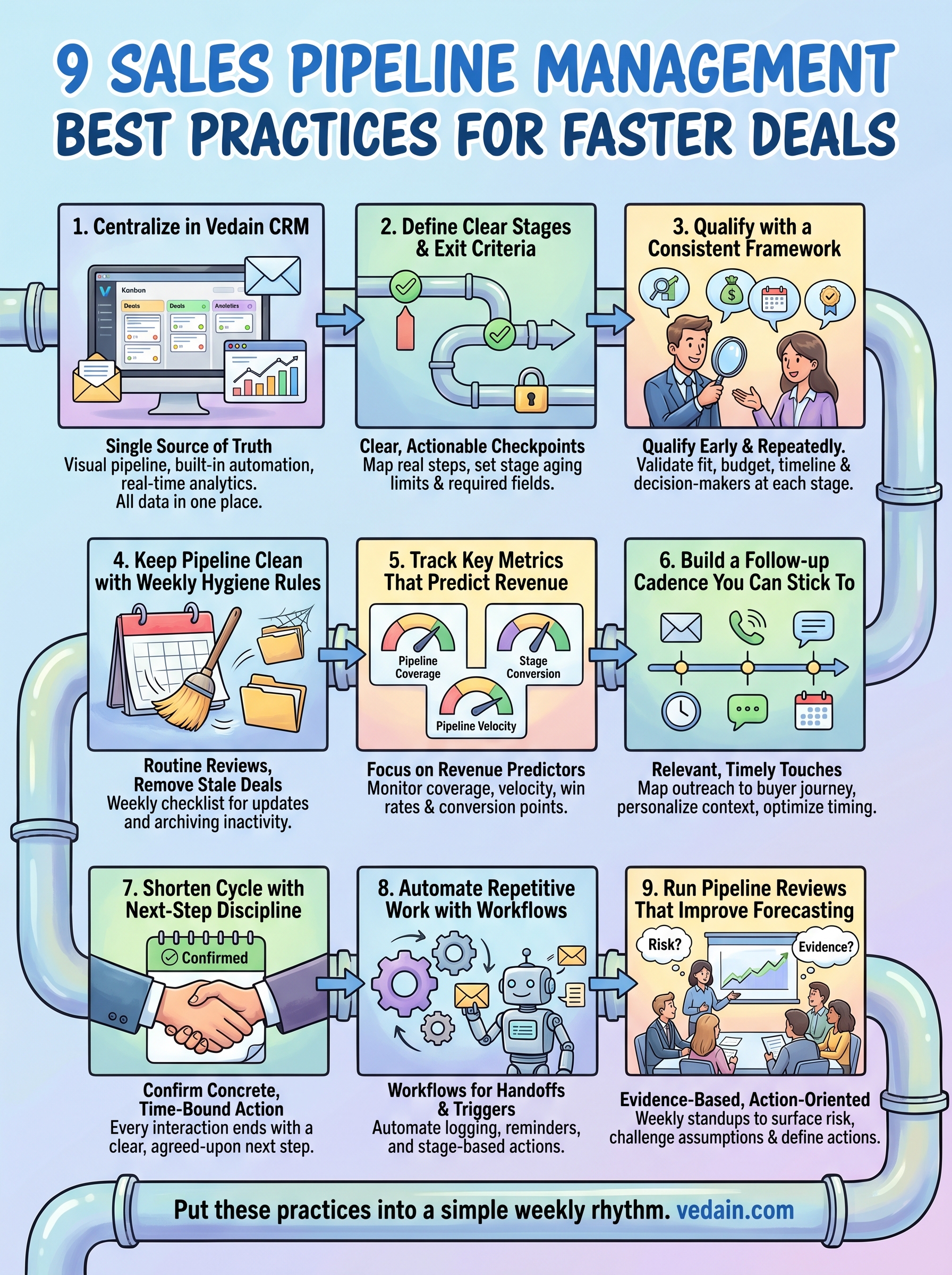
Put these practices into a simple weekly rhythm
None of these sales pipeline management best practices work in isolation. The teams that see the biggest gains treat them as a connected system rather than a checklist of one-time improvements. Each practice reinforces the others, and the weekly rhythm is what keeps the whole system running.
Your daily focus should stay on logging activity, confirming next steps, and updating deal stages. At the weekly level, run your hygiene review, check your metrics dashboard, and hold a team pipeline call that ends with clear action items. Monthly, revisit your stage definitions, qualification criteria, and automation sequences to catch drift before it damages your forecast.
Vedain CRM is built to support this entire rhythm in one place, from automated workflows to visual pipeline reports, without locking features behind a higher pricing tier. Start your free trial of Vedain CRM and get your pipeline running on a system your whole team can follow.