A well-managed pipeline gives you a clear picture of where every deal stands, what needs attention right now, and where your process is leaking revenue. Without that clarity, you're relying on gut feeling, and gut feeling doesn't scale. The good news: pipeline management is a skill you can build with the right framework and habits.
This guide breaks down the full process, from defining your stages and tracking the right metrics to automating the repetitive work that slows your team down. We built Vedain CRM specifically to make this easier: a visual deal pipeline, workflow automation, and real-time reporting all included at a flat $10/user/month. Whether you're setting up your first pipeline or fixing a broken one, you'll walk away with a practical system you can apply immediately.
What you need before you manage a pipeline
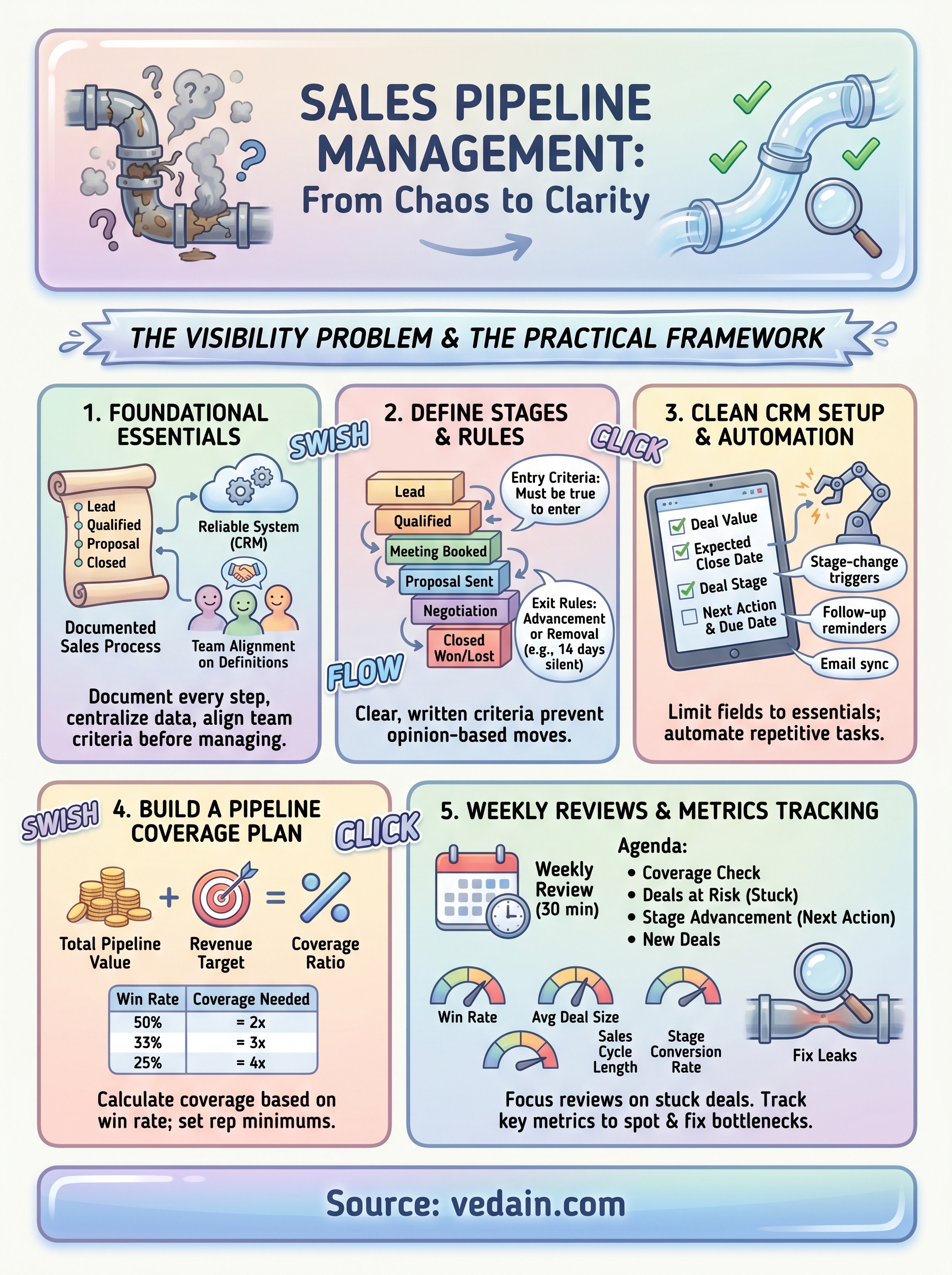
Jumping straight into pipeline management without the right foundation is like trying to run a meeting without an agenda. Before you can learn how to manage a sales pipeline effectively, you need three things in place: a documented sales process, a reliable system to track every deal, and shared definitions across your entire team. Skip any one of these and your pipeline will drift back into chaos within a few weeks, no matter how good your intentions are.
A documented sales process
Your sales process is the backbone of your pipeline. Without it, every rep invents their own version of what "qualified" or "proposal sent" actually means, and your pipeline data becomes noise. Document every step a deal takes from first contact to closed, including what triggers the move from one stage to the next and what disqualifies a deal entirely.
Start by mapping your current process on paper or a whiteboard. List every action your team takes, then group those actions into five to seven distinct stages that reflect your real sales motion. A practical starting structure looks like this:
Your stages should reflect how your buyers actually buy, not how you wish they would.
Adjust the structure to match your actual sales cycle length and complexity. A two-week SaaS close and a six-month enterprise contract need different stage breakdowns.
A place to track every deal
Spreadsheets break down fast once your pipeline grows past 20 or 30 active deals. You need a central system where every deal lives, including the contact name, deal value, current stage, next action, and expected close date. Without centralized tracking, deals fall through the gaps and your forecast is guesswork at the end of every month.
A CRM solves this automatically. Vedain CRM gives you a visual Kanban pipeline where you can see every deal at a glance, filter by rep or stage, and update records in seconds. Setup takes under five minutes, you get unlimited records, and the full feature set costs $10 per user per month with no hidden tiers.
Team alignment on key definitions
Your pipeline is only as accurate as the data your team enters. If one rep marks a deal "Qualified" after a cold email reply and another waits until a 30-minute discovery call is done, your stage-level reports mean nothing. Align your team on exact entry and exit criteria for each stage before you build anything in your CRM.
Write a short reference document that defines each stage in plain language. Include a concrete example for each stage so there is no room for interpretation. Review it quarterly to make sure it still matches how your sales motion actually works. This step takes less than an hour but protects you from weeks of corrupted pipeline data down the road.
Step 1. Define stages, entry rules, and exits
Knowing how to manage a sales pipeline starts with knowing exactly what each stage means. Without written entry and exit rules, your reps will disagree on where a deal actually sits, and that disagreement poisons every metric you try to track. Defining your stages once, clearly, saves you from correcting bad data every single week.
Write entry criteria for every stage
Entry criteria answer one question: what must be true before a deal moves into this stage? Leaving that question unanswered means every rep decides independently, which means your pipeline reflects opinions instead of facts. Write one or two hard conditions for each stage and put them somewhere your team can find in 30 seconds.
Here is a concrete template you can adapt directly:
If a deal does not meet every entry condition, it belongs in the previous stage, no exceptions.
Keeping the criteria tight means your stage-level conversion rates actually reflect reality. That data is what lets you spot where deals consistently stall.
Lock down your exit rules
Exit rules define when a deal leaves a stage, either forward to the next stage or out of the pipeline entirely. Most teams only define forward movement and ignore the disqualification rules, which lets zombie deals sit in the pipeline for months and inflate your forecast.
For each stage, write two exits: one for advancement and one for removal. For example, a deal exits "Qualified" forward when a meeting is booked and confirmed. It exits out entirely when the prospect goes silent for 14 days after two follow-ups. Document both, review them quarterly, and update them any time you notice a pattern of deals stalling at the same point.
Step 2. Set up your CRM for clean data
A CRM is only useful if the data inside it is accurate. Part of knowing how to manage a sales pipeline is recognizing that a cluttered, inconsistently filled CRM gives you worse visibility than a simple spreadsheet. Set up your CRM intentionally from day one so your reps spend less time entering data and your reports actually reflect reality.
Pick the right fields and skip the rest
Every field you add to a deal record is a field your reps have to fill in. Add too many and they skip half of them, which means your data has gaps in all the wrong places. Limit your required fields to only the ones you will actively use in reporting or qualification decisions.
Start with these core fields for every deal record:
Fields with no reporting purpose are just friction. Remove them before your team builds bad habits around skipping them.
Once you have your core fields locked in, mark them as required in your CRM settings so no deal can move forward without them. In Vedain CRM, you can add custom fields and set required rules directly from the pipeline view in under two minutes.
Build automation to reduce manual entry
Manual data entry is where pipeline hygiene breaks down. The more steps you ask your reps to handle by hand, the more likely something gets skipped or entered wrong. Use your CRM's automation tools to handle the repetitive work automatically.
Set up these three automations first:
- •Stage-change triggers: Automatically log a timestamp and notify the rep's manager when a deal moves to Proposal Sent or Negotiation.
- •Follow-up reminders: Create a task automatically when a deal has had no activity in five business days.
- •Email sync: Connect Gmail or Outlook so every sent email logs to the deal record without the rep lifting a finger.
These three automations alone cut most of the manual logging work and keep your pipeline data current without adding work to your team's day.
Step 3. Build a pipeline coverage plan
A pipeline coverage plan tells you how much pipeline value you need to reliably hit your revenue target. Without one, you are flying blind into every quarter. Pipeline coverage is the ratio of your total open pipeline value to your revenue goal, and understanding this number is a core part of knowing how to manage a sales pipeline at any scale. Most sales teams skip this step entirely and then wonder why they miss quota even when the pipeline "looks full."
Calculate your coverage ratio
Your coverage ratio is simple: divide the total value of all active deals in your pipeline by your revenue target for the same period. If your quarterly target is $100,000 and your pipeline holds $300,000 in open deals, your coverage ratio is 3x.
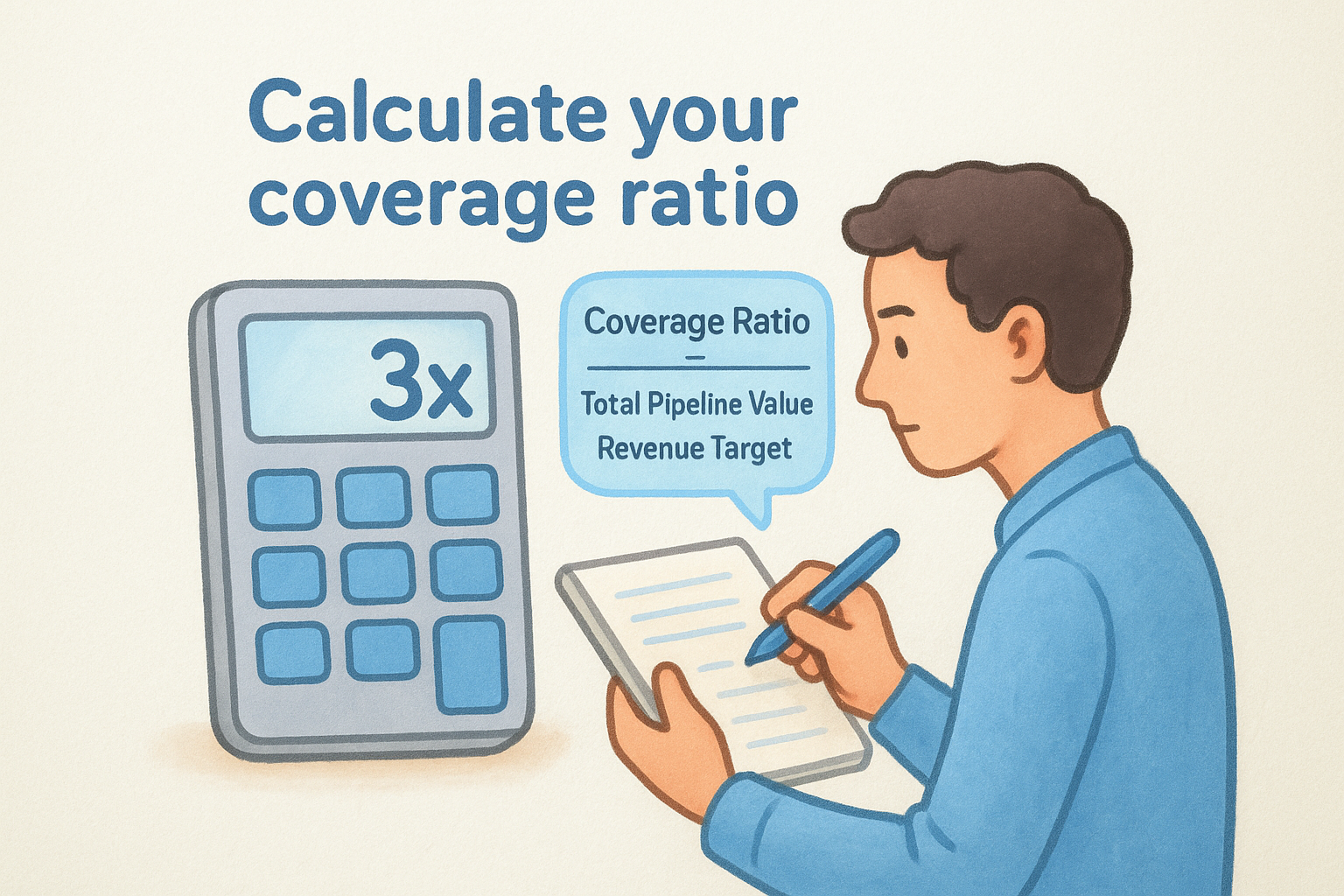
A 3x coverage ratio is a common starting benchmark, but your actual target depends on your historical close rate.
Here is the formula to apply directly:
Coverage Ratio = Total Pipeline Value / Revenue Target
To find your right coverage target, pull your average win rate from the last two or three quarters and work backward:
If your team closes 25% of opportunities on average, you need four dollars of pipeline for every one dollar of target. Update this calculation at the start of each quarter using actual historical data, not estimates.
Set coverage minimums per rep
Team-level coverage numbers hide individual gaps. Break the coverage plan down by rep so you can spot who is understocked before it becomes a revenue problem. Set a minimum pipeline value threshold for each rep based on their individual target and close rate.
Run this check every Monday. If a rep's pipeline falls below their minimum coverage threshold, treat that as an immediate priority, not a note for the next meeting. Pair the coverage check with a lead sourcing conversation so the gap gets filled within the same week, not the same month.
Step 4. Run a weekly pipeline review that works
A weekly pipeline review is one of the highest-leverage habits in knowing how to manage a sales pipeline consistently. Most reviews fail because they turn into status updates where reps recite deal notes and managers nod along. A review that actually works is forward-focused: it identifies what needs to happen in the next seven days to keep each deal moving, not what happened in the last seven.
Set a repeatable agenda
Without a fixed agenda, reviews drift. Cap your review at 30 minutes and follow the same structure every week so your team comes prepared instead of improvising. Consistency is what makes the meeting useful rather than performative.

Use this agenda template for every session:
The goal of a pipeline review is decisions and commitments, not a recap of what already happened.
Focus on deals that need action, not deals that are going well
Healthy deals do not need meeting time. Spend the bulk of your review on deals that are stuck, close to stalling, or sitting in a stage too long without a next action logged. Every deal should have a clear next step with a specific due date before the review ends.
Ask three questions for every stuck deal: What is blocking forward movement? What does the rep need to unblock it? What happens if nothing changes by next Friday? These questions force a real conversation and produce actual commitments instead of vague plans. When a deal cannot answer all three, it belongs in a lower stage or out of the pipeline entirely until activity picks up again. Running the review this way trains your team to keep deals current between sessions because they know exactly what you will ask each week.
Step 5. Track metrics and fix bottlenecks
Tracking the right numbers is a core part of knowing how to manage a sales pipeline well. Without metrics, you can only react to problems after they already cost you revenue. The goal is to spot where deals slow down or drop out, then change something specific in your process before the same pattern repeats next quarter.
The five metrics that matter most
Your pipeline produces a lot of numbers, but most of them are noise. Focus on five metrics that directly reflect pipeline health and give you enough signal to take action on what you find.
Stage conversion rates are the most actionable metric: a sudden drop at one stage tells you exactly where your process is breaking down.
Calculate pipeline velocity using this formula: multiply the number of active deals by your average deal value and win rate, then divide by your average sales cycle in days. This single number shows how much revenue your pipeline generates per day and whether that rate is trending up or down over time.
How to identify and fix a bottleneck
A bottleneck appears when deals pile up in one stage and the conversion rate to the next stage drops below your historical average. Pull your stage conversion report every week and compare each stage against your baseline numbers from the previous two quarters.
When you find a stage where the drop-off is steeper than normal, ask three diagnostic questions: Are reps moving deals in before entry criteria are met? Is the messaging at that stage not addressing the buyer's real concern? Is too much time passing between follow-ups? Each answer points to a specific fix, whether that means tightening entry rules, revising your proposal template, or cutting your follow-up gap from ten days to five.
Change one variable at a time, then track that same stage conversion rate for four weeks before adjusting anything else. Testing multiple changes at once makes it impossible to know what actually moved the number.
Keep your pipeline healthy
Knowing how to manage a sales pipeline is not a one-time setup task. It is a habit you build through consistent reviews, tight entry criteria, and accurate data. Every step in this guide compounds: clean stage definitions lead to better data, better data leads to useful metrics, and useful metrics let you fix bottlenecks before they cost you a quarter.
Start with what you can control today. Pick one weak point from your current pipeline, whether that is stale deals with no next action, missing coverage, or a stage where deals consistently stall, and fix that single thing this week. One focused improvement beats five half-finished ones every time.
When you are ready to put all of this into practice with a tool built around the same principles, try Vedain CRM free. Visual pipelines, workflow automation, and real-time reporting are all included at $10 per user per month with no feature gates.